


Fundraising in Web3: How to raise capital
Reading time:
Category:
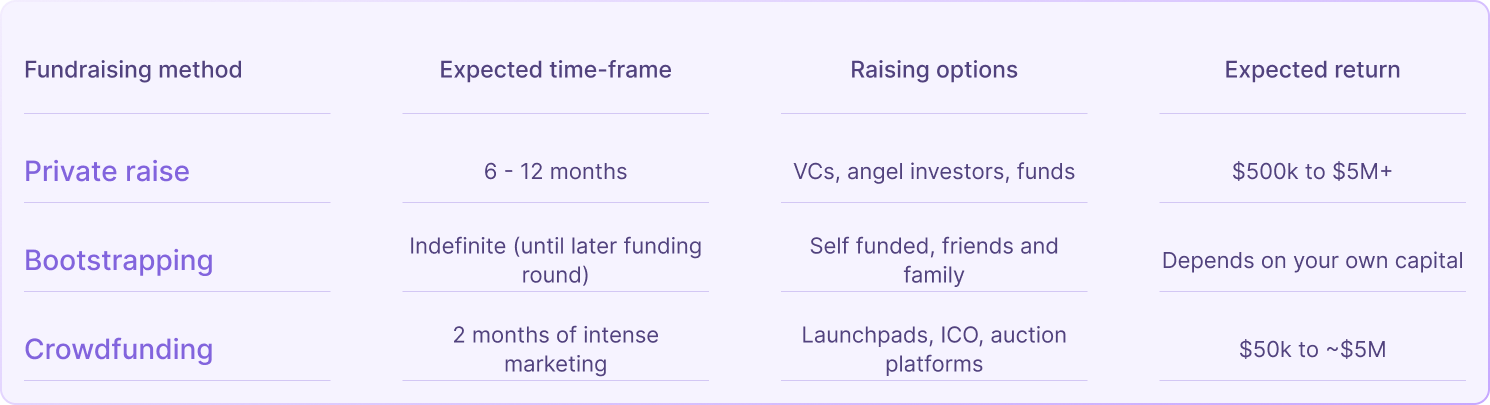
No business can be grown without capital, that’s nothing new. But where does that capital come from? In Web3, there are a few avenues that most founders take in order to ensure adequate funding for their business. These are the most common models and when each of those makes the most sense
No business can be grown without capital, that’s nothing new. But where does that capital come from? In Web3, there are a few avenues that most founders take in order to ensure adequate funding for their business. These are the most common models and when each of those makes the most sense:
Private fundraising, raising capital from VCs and investors
A private raise is one of the most ‘convenient’ approaches to funding a company. If you’re able to attract capital injections from investors, realizing your goals becomes much easier, much quicker. It does however come with its own difficulties and characteristics that you should be aware of. If you’re planning to raise capital from investors, here’s what you need to keep in mind:
- Structure your company and tokenomics for a raise
- Reserve a portion of your tokens for a capital raise (Usually this amounts to anywhere between 10% to 25%, sometimes 30% of your total token supply). The more of your token supply you’re selling, the more volatility you might bring to your token, as well as potentially impacting the future of your company. Structure your token sale(s) with vesting schedules that support your business goals and protect your interests
- Reserve a portion of your company’s equity for investors (Same as for the token supply, between 10% and 30% should be reserved for investors). Nowadays most investors will be interested in the equity of your company to an equal amount as your token supply, especially if your company is generating revenue
- Prepare fundraising materials
- You will need a pitch deck outlining your product, roadmap, your team and future growth projections. You need to be able to communicate the future and vision of your company with confidence in order to attract capital.Include backgrounds of your core team members, the current standing and traction of your company, how you expect and plan to grow your company and articulate them well. Doing a bit of research into examples for pitch decks will help you start and compare.
- Be prepared for investor relations
- Investors want to make informed decisions, so you will need to be open and available to their questions and be prepared to answer them properly. Convey confidence in your approach and your abilities and be realistic with your projections and goals
- Keep investors informed of your progress and your company’s overall health. Your investors might be able to help you overcome certain hurdles you will encounter through leveraging their network or simply through their experience with other startups
- Be willing to go the extra mile
- Investors get numerous investment opportunities and proposals almost on a daily basis, so you not only need to stand out, you also need to make sure to reach as many investors as possible. Use resources like linkedin, tech accelerators and others to get in touch with investors. The more the merrier. Be tenacious, if it takes 100 emails to attract capitals, send those 100 emails and more, if you succeed in raising capital, it will be worth the effort
What are the benefits of doing a private fundraise?
- More capital
- Clean and simple - you’ll have more money to build your business with, which will open doors for you that would otherwise stay closed
- A larger network
- VCs and other investors usually have a large network of companies, other investors, service providers and more, which they will make available to you in order to help you grow your business. If your business grows, their investment grows, it’s a simple win-win
- A stamp of approval
- An investment from a VC brings a certain level of prestige to your company. Since any investor or investment company will perform a series of due diligence related processes before investing in your company, that shows the world that you qualify, which can often go a long way in the web3 world
What are the downsides of a private fundraise?
- Less control
- Accepting external capital will come with a set of stipulations. Those can be legal stipulations, based on your company setup or through the contracts you sign with investors for example, but also simply because you own less of your token supply or your company itself
- A degree of dependency
- Most investors have been around for a while and they have established networks as well as processes that they might want you to follow or adhere to. Often it can even be the case that those are contingencies based on their investments. Be careful what you agree to
- Predatory behavior
- While investors usually have motivation to see your company grow and succeed, their business model is profiting off of your company or token supply. If they get a chance to capitalize on their investment, they will. This is in no way surprising, but it can make for a difficult situation for you in a market where token performance is an important metric
Here’s a checklist of things you need to be ready for a private fundraise:
- Raise materials (Pitch deck, public data-room, growth-projections, etc….)
- Legal documents for your sale (SAFT, SAFE + token warrant)
- A network of investors to contact
Bootstrapping instead of fundraising
Bootstrapping refers to a more traditional business model and strategy, in which you would start with your own capital first, grow your business to a certain size and become profitable through simply operating and ideally growing your business.
If you choose to go that route, make sure to:
- Budget your approach
Since you’re relying on just your own capital, you most likely have a limited amount of money to spend, so you’ll need to make sure to make your budgetary decisions carefully. Running out of capital is the worst thing that can happen to a startup. Choosing the right team members, the right tools to use, etc. will be important to limit wasteful spending
- Focus all of your efforts on growing your business
- If your company relies on its own success, do everything you can to grow your business and revenue. It’s business strategy 101 basically. Analyze what’s bringing in revenue, what grows revenue and focus on that. To grow your business you will need funds, which will come from the revenue that you generate. Anything that doesn’t generate revenue already, or most likely won’t in the long run, is a waste of time and money
- Find good partners
- Finding good partners can be essential here. Doing everything yourself, or even with a small team can quickly become overwhelming, so try to find companies or individuals who can help you. Advisors, agencies and others that may be able to fill the gaps that are between you and your team. The partners you choose will have a big impact on your business overall, so make sure to do your due diligence and focus on partners that can help you grow your business and revenue. Sharing revenue is not a bad option if you can increase your revenue overall for example, but hiring business advisors that bleed your reserves dry will quickly lead to problems. Don’t trust, verify
What are the benefits of bootstrapping?
- More freedom
- If ‘only’ your money is at stake, you are in full control of your company. If you decide one strategy is good for your business, no one can tell you to do otherwise
- A more natural growth
- Whether in marketing, or simply through your product’s offering, most people value authenticity and an organic approach. Growing your business from the ground up builds character and branding for your company, which will be appreciated
What are the downsides of bootstrapping?
- More pressure
- Bootstrapping means your business has to be successful in order to survive and thrive. If you’re not successful, you’ll eventually need to close your business
- It’s more difficult
- Growing a business from zero is the most difficult aspect of it all. You’ll need to learn, try, sometimes fail and improve. All of which will cost time, effort and money
Here’s a checklist of things you need to be ready for bootstrapping:
- Ample marketing (large and engaged community, regular posts, etc….)
- Roadmap with clearly outlined milestones (at least for the next 3 years)
- A strong and well-selected team to help you execute

Crowdfunding: raising funds from your community
Raising money from the community is a very established method of raising funds nowadays. Whether it is through a public sale on a launchpad, through an ICO, or even through other platforms that allow for price discovery through auctions.
While mobilizing a large amount of people can be beneficial, make sure to be aware of what that entails:
- Impact on how you’re perceived
- Raising money from any investor means much more scrutiny coming your way, but raising money from your community / retail investors, means that times ten. No one will scrutinize you as much as your own community will, so you will need to ensure your public communication and your marketing are in order. You can be confident, you can be bold, but you will have to ensure you can reach the goals you’re proclaiming. Plan, announce, deliver
- Focus on marketing
- If you’re planning to rely on your community for capital, you’ll need to build a strong, engaged and dedicated community. Marketing is your key weapon here, without proper marketing strategies in place, people won’t even be aware of your fundraise. Engage your community as much as you can. The nature of web3 makes for a dynamic in which your community has an incentive to see you succeed, use that to your advantage and turn interested people into your followers and advocates
- Potential capital limitations
- While you may be able to raise from a large amount of people, it won’t always equate to raising a large amount of capital. Retail investors (your community) naturally don’t have the resources professional or seasoned investors have, so the amount of capital you’ll be able to raise may be smaller than compared to other fundraising methods
What are the benefits of crowdfunding?
- Marketing effect
- Crowdfunding is one of the most engaging activities and opportunities for your community. You’re giving your community and anyone interested an opportunity to own a piece of your company, which you can leverage to a large extent through your marketing efforts
- Wide token distribution
- Selling your token to a large audience means that your token will be distributed to a much larger amount of people and wallets than it would be compared to other raise methods. This is great because now you have a large number of stakeholders, who have interest and incentive in your company and token succeeding
- Existing platform communities
- Besides your own community, you can leverage existing investor communities through platforms such as launchpads or token auction platforms. Those usually come with their own marketing campaign, which can help amplify your own efforts
What are the downsides of crowdfunding?
- More dependant on market conditions
- While you’re always dependent on market conditions in web3, crowdfunding makes you even more so. Since retail investors have more to lose, they’re more cautious with their money. If the market doesn’t look good, they probably won’t invest
- The outcome is crucial
- The success of your raise through crowdfunding is a major signal for investors and anyone interested in investing or your product in general. If, for whatever reason your raise is not successful, it’s a clear sign for interested parties to stay away, as you weren’t able to generate enough interest
Here’s a checklist of things you need, to be ready for crowdfunding fundraise:
- The right partners (launchpads, influencers, etc…)
- A strong community (to generate enough interest in your token sale)
- Clear strategies for managing your token supply (what will the future of your token look like)
Crypto fundraising FAQ
What is the best way to raise funds in crypto?
- It depends on your project. If you’re looking for more assurance and less turbulence, try a private raise, but if you’re looking to generate a lot of attention, try crowdfunding. If you don’t need as much capital upfront, or already have capital you want to use, build your business and grow its revenue organically.
How much money can I raise?
- Amounts vary. Private raises range from around $500k up to $20M and more, crowdfunding usually between $100k and $5M, sometimes more. It depends on how well you can communicate and promote your company to investors.
Do I have to raise money?
- Not at all. If you’re already sufficiently funded to build the product you envisioned, just do that. The less money you accept from external investors, the more freedom you have.
What do I need to raise funds in crypto?
- For any type of raise you’ll need a variety of things, such as a pitch deck, data-room, growth projections and others for a private raise. What’s unique about web3 is that in almost any case, you will need a strong and engaged community. Social capital goes a long way in web3.
Conclusion
There are many ways to achieve or ensure sufficient capitalization for your company, each of those fundraising methods discussed comes with its own benefits and downsides you will need to consider when envisioning and planning the future of your company.
Take your time and choose wisely, stick to your vision and your plan and make a decision that fits that vision.
Reference: https://crypto-fundraising.info/deal-flow/


